Silver is the New Gold
Inside India’s Silent $100B Senior Economy Where Grey is the New Green

In a country obsessed with youth, it's easy to miss the quiet revolution already underway.
India is aging, and, fast.
A retired teacher in Kolhapur taps her smartphone to book a hospital visit. She can forward a voice note on WhatsApp, but the labyrinth of a medical app leaves her stuck. Her children, both NRIs, offer support from afar.
She doesn’t need charity.
She needs systems that see her.
She is one of 138 million Indians over 60-a demographic that holds assets, makes decisions, and remains largely invisible to modern product design.
India’s senior population, now over 10% of the total (Source: Government of India Population Projection Report, 2011–2036), is growing nearly five times faster than the general population (projected 40% growth from 2021–2031 vs. 8%). Many of these individuals are living longer, living alone, and living with dignity-but not with ease.
The popular narrative of India as a young nation misses the bigger picture: while youth may power our present, it’s age that will define our future.
The Shape of the Opportunity
This isn’t about sympathy.
It’s about scale.
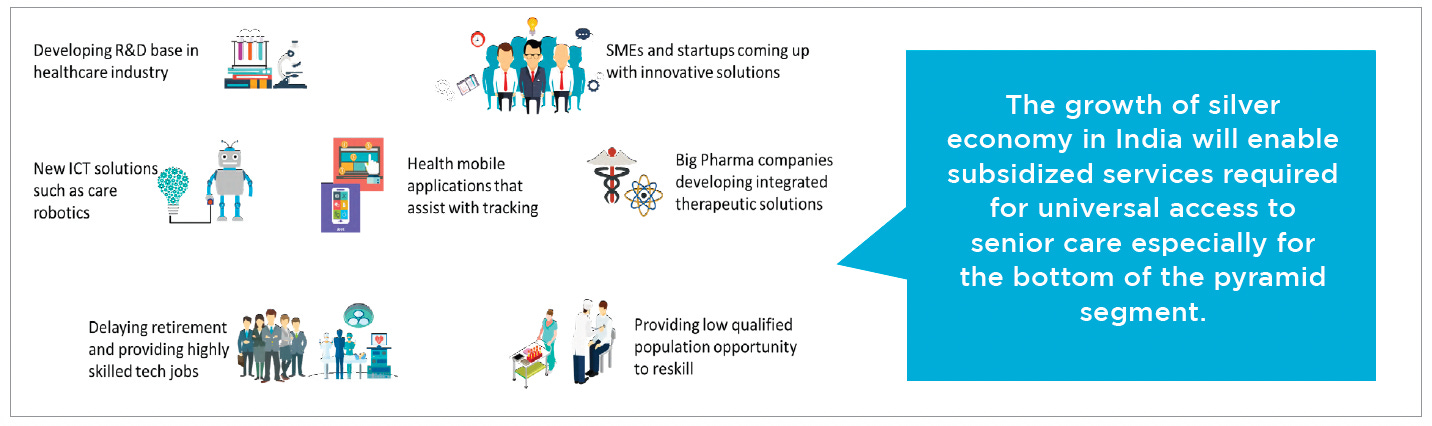
India's senior economy represents a market-in-waiting estimated at $100 billion across sectors like financial services, healthcare, wellness, lifestyle, and daily support (Source: Blume Ventures & Eldercare Blueprint, 2024). This figure includes both core and adjacent categories, factoring in public and private sector demand, household expenditure, and rising product penetration.

Financial Services
Seniors face unique financial realities. Traditional credit systems overlook pension-based or asset-backed stability. This space includes pension-linked loans, reverse mortgages, annuity-backed income tools, and simplified, fraud-resistant senior accounts. New underwriting models could unlock both dignity and demand.Healthcare and Insurance
With higher rates of chronic illness, co-morbidities, and poly-pharmacy, elder-specific healthcare requires integrated care models. Think at-home diagnostics, remote consultations, preventative screenings, and dedicated IPD care navigators. Meanwhile, insurance models must shift from exclusions and age caps to lifetime adaptability and simplified claims. Coverage today is estimated to reach less than 2% of seniors (Source: Eldercare Blueprint, 2024).Lifestyle and Recreation
From travel to wellness, this is the most overlooked area. Seniors with moderate-to-high disposable incomes seek curated religious and leisure travel, accessible fitness programs, and peer companionship. Group holidays for elders are now priced at 1.2x to 3x standard tours because they offer what mainstream travel doesn’t: comfort, care, and inclusion (Source: Eldercare Blueprint, 2024).Daily Enablement
Concierge support, elderproofed homes, and hybrid analog-digital interfaces can transform everyday frustration into ease. These solutions are sticky and habit-forming when done right.
In cities, nearly 77% of seniors use smartphones (Source: Eldercare Blueprint, 2024). But digital comfort doesn’t equal digital confidence. Seniors are digitally adjacent-comfortable with assistance, not autonomy.
This isn’t a tech-averse audience.
It’s a design-neglected one.
Aging in Place, Not in Peace
Globally, we’ve seen state-backed responses to aging. The Netherlands uses municipal-level delivery for long-term and social care, coordinated with income support. Turkey funds cross-ministerial, in-home health and personal care systems, often delivered by multidisciplinary teams (Source: WHO Long-Term Care Country Profiles, 2023).
India has pieces of this puzzle:
EPFO pensions, Ayushman Bharat, and a maturing digital rails stack. But integration remains elusive. What seniors experience isn’t a system. It’s a maze. The process of filing a claim, renewing a policy, or simply updating KYC details is still a high-friction, low-trust environment.
This is where concierge-led models are stepping in. They assist with doctor appointments, transportation, health policy selection, and medication reminders. More than operational support, they offer emotional consistency. A recurring check-in call becomes more than a service; it becomes safety.
A caregiver employed by an elder care company in Mumbai who works closely with dementia patients explained her experience:
"It’s not just about getting things done. Sometimes they just want to talk. You become a routine in their life, like chai at 4pm."
These models are people-heavy.
But they are loyalty-rich.
Retention rates are strong.
Churn is low.
LTV is meaningful.
And in a segment where the payer is often different from the user, trust-not tech-is the bridge.
Lessons from the World's Oldest Superpower
Japan is both cautionary tale and aspirational case study. Over 29% of its population is now over 65 (Source: Statista, 2024). The “2025 Problem” refers to the collision of an aging population and underprepared infrastructure.
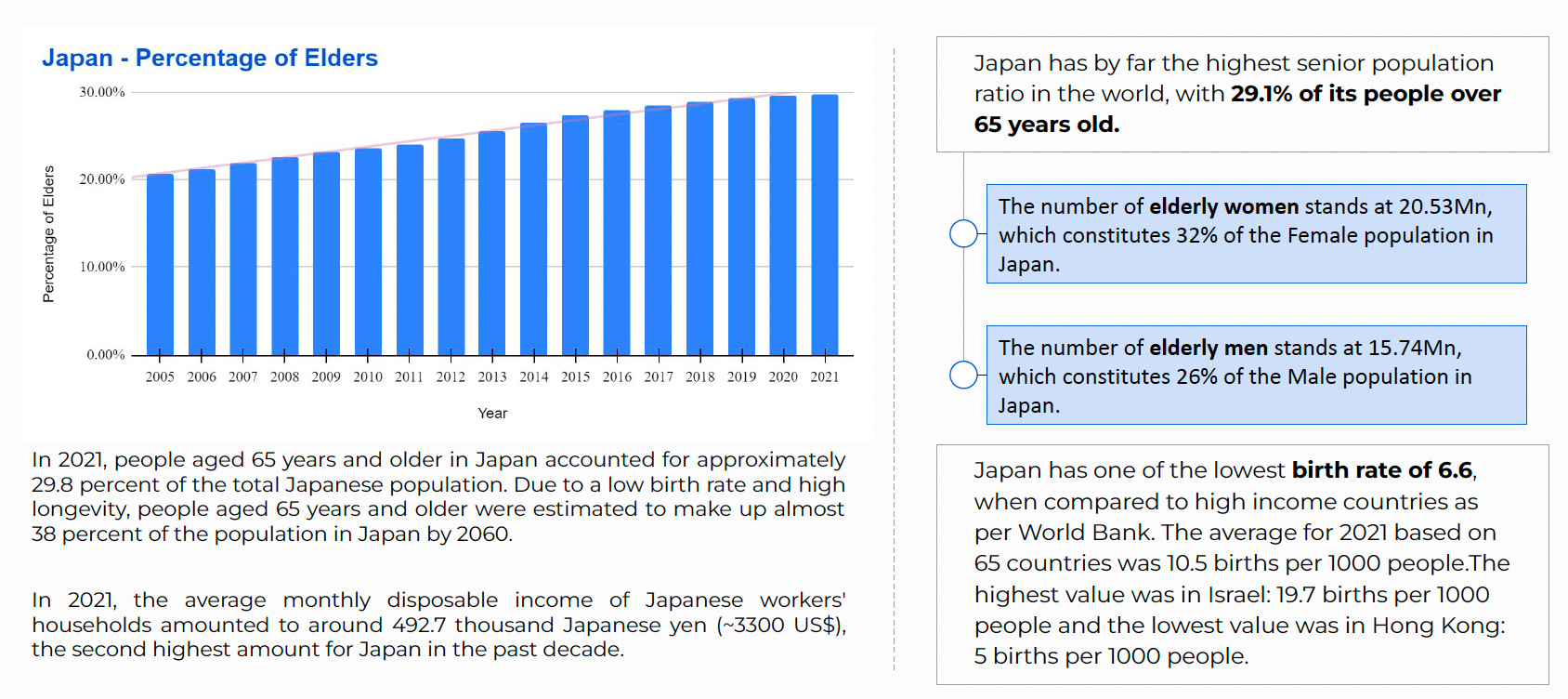
Japan’s response has been layered:
Universal Long-Term Care Insurance (LTCI), covering up to 90% of costs (Source: OECD Health Data, 2023)
Tech-embedded care like robotic aids, sensor-based safety systems, and voice-led interfaces
Community-centered interventions, such as neighborhood alert systems and companionship programs
Yet, even Japan faces caregiver shortages and rising isolation deaths (kodokushi).
The lesson?
Tech cannot substitute for care.
At best, it enables it.
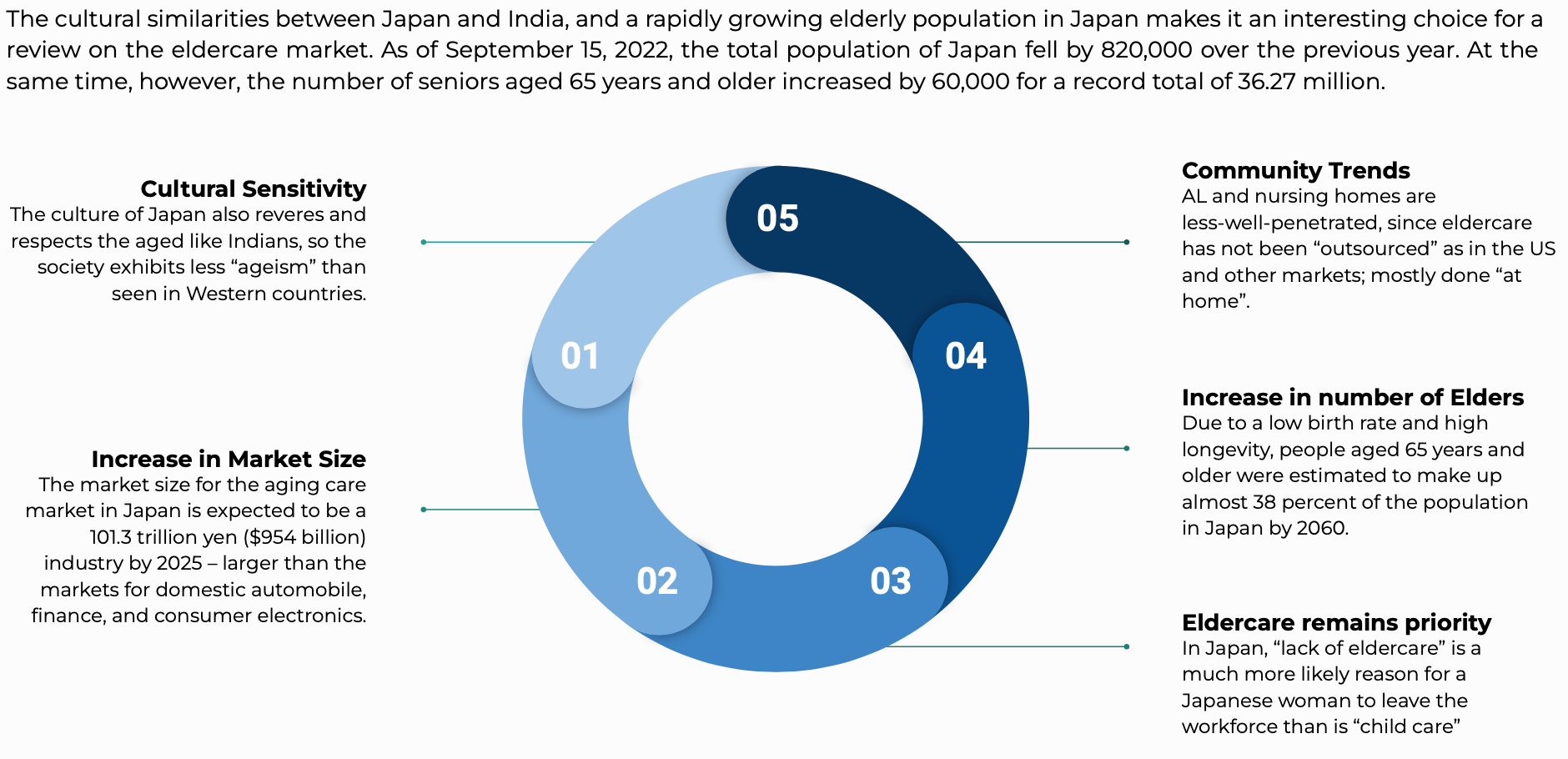
India, with its demographic dividend still in transition, can leapfrog. Its advantage lies in its emerging DPI infrastructure, its social capital of family and community, and its entrepreneurial agility. But the window to act is closing.
The Frictions to Solve
Invisible Creditworthiness
Seniors have assets but no income trail. Traditional models exclude them. Pension-linked loans, asset-backed credit, and co-guarantee models are necessary. Financial identity must be redefined.Digital Distrust
Seniors aren’t rejecting tech. They’re rejecting opacity. Interfaces must be accessible, error-forgiving, and offer escalation paths to humans. Tech that listens builds confidence.Ops-Heavy, Loyalty-Rich
Human-led models are hard to scale, but the depth of engagement creates long-term value. Investors must recalibrate their lens from CAC-to-LTV to CAC-to-trust.The Payer-User Split
When the user is an elder and the payer is their child (often NRI), product flows must be dual-sided: emotionally intelligent for the parent, operationally seamless for the child.
From the Field
A founder of an eldercare startup recently shared an interesting insight:
"Our users didn’t want push notifications. They wanted someone to call and say, 'We’ve booked your doctor for 11 AM and the car will be there at 10:15 AM.' That call built more trust than any feature ever could."
That’s the central tension: automation may scale, but reassurance retains.
The Cheat Sheet: Building for the Elder Economy
Design for Trust, Not Speed: Human contact isn’t a delay-it’s the product.
Pair the Payer with the User: Dual-flows that respect agency and enable coordination.
Finance Is Infrastructure: Redesign credit and insurance for longevity, not just liquidity.
Community Is Product: Build for companionship, cultural continuity, and routine.
Train the Trust Layer: Create eldercare jobs as dignified, skilled, and scalable.
Anticipate the Crunch: Japan shows us what happens when you wait. India has a chance to build ahead.
Grey isn’t just the new green.
It’s the new gravity.
And how we hold it will define what we build next.
Insightful